
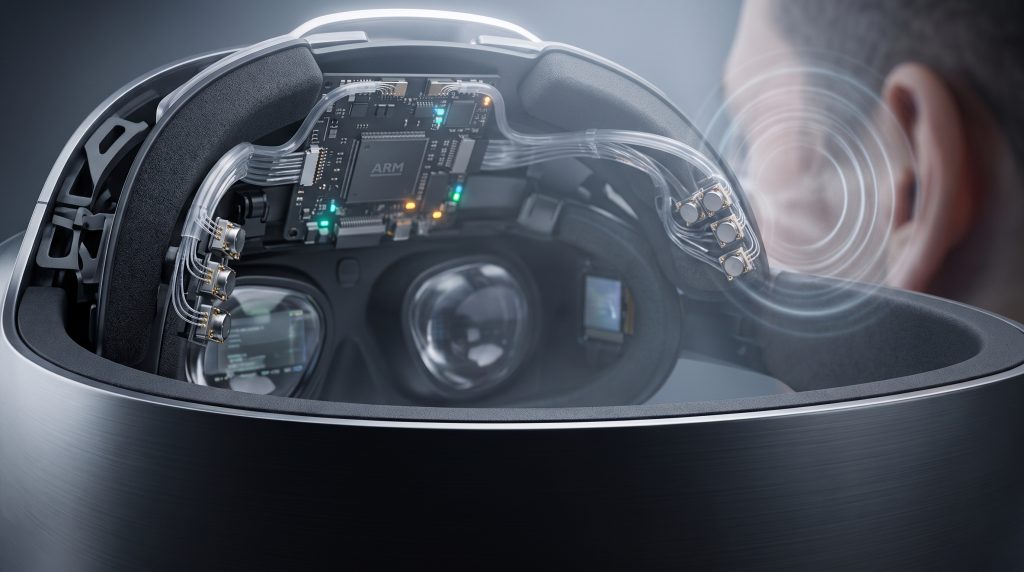
Arm, the chip design company behind most mobile and XR processors, has been granted a patent for a head-mounted system that uses ultrasound to interact directly with the wearer’s vestibular system. The goal stated in the filing is to reduce the dizziness and nausea that occur when what a user sees in a headset doesn’t match what their inner ear reports about movement.
The patent, titled “Method for minimising motion sickness for head-mountable extended reality,” was filed in the US on July 24, 2023, and granted on June 16, 2026.
What the patent actually describes
The system monitors visual motion in the images sent to the display and compares it against a threshold. When the visual movement is significant enough to risk triggering discomfort, processing circuitry sends signals to ultrasonic transducers positioned to stimulate the vestibular system, the sensory apparatus responsible for balance.
The filing focuses on low-intensity focused ultrasound (LiFU). One example in the patent describes a small leftward visual shift being matched with a corresponding low-intensity physical sensation of leftward motion; a larger shift would use greater acoustic radiation force to produce a stronger cue. The design allows for one or more transducers per ear, with beamforming potentially used to target specific regions of the inner ear.
Ultrasound stimulation isn’t presented as the only lever. The same system could also instruct the XR application to slow down visual motion, fade the image, add a vignette effect, or otherwise realign what’s displayed with the user’s actual movement. The patent also references adjusting stimulation based on the wearer’s pose, personal calibration settings, and sensor data, with a recalibration mechanism if sensed movement doesn’t match expected visual motion.
Not the first attempt at vestibular comfort
Direct stimulation of the vestibular system as a countermeasure for motion sickness isn’t a new idea. Other approaches, including some based on electrical rather than ultrasonic stimulation, have been explored in the past. What’s notable here is the source: a company whose architecture sits inside the vast majority of mobile and XR processors, including chips branded Snapdragon and Apple Silicon.
Despite this history of research, no commercially available XR headset currently ships with any form of direct vestibular stimulation. Comfort features on the market today rely on software-side solutions: reduced field of view during fast motion, vignetting, snap turning, or teleport-based locomotion.
What a granted patent does and doesn’t mean
A granted patent confirms that Arm has secured legal protection over this specific method. It does not confirm that any product will use it, on what timeline, or with what hardware partner. Patents in the XR space are frequently filed years ahead of any commercial application, and many are never implemented at all.
The open technical question is whether ultrasonic vestibular stimulation, delivered through a head-mounted array, can produce a precise and comfortable sensation across a wide range of users and content types. Individual differences in inner-ear anatomy, sensitivity to motion, and tolerance for ultrasonic stimulation are all variables the patent doesn’t resolve. As Road to VR notes, this remains a description of intent to protect an idea, not evidence that the described experience feels good — or works reliably — in practice.
La lettura di DIVE
Per chi progetta esperienze immersive, il motion sickness resta uno dei limiti più concreti alla scalabilità della VR, soprattutto in contesti dove l’utente non è un early adopter abituato al mezzo: un visitatore museale, un operatore in formazione, un dipendente pubblico che prova un simulatore per la prima volta. Le soluzioni software attuali — vignette, riduzione del campo visivo, locomozione a teletrasporto — funzionano, ma limitano anche il design dell’esperienza: spesso si rinuncia a movimento libero o a contenuti dinamici proprio per non scatenare disagio.
Un sistema hardware che agisce direttamente sul sistema vestibolare, se mai arrivasse sul mercato, cambierebbe i vincoli progettuali più che l’esperienza percepita: significherebbe poter disegnare sequenze con movimento della camera più libero, senza dover compensare ogni scena con espedienti visivi che riducono l’immersione. È un problema che riguarda direttamente progetti come simulazioni di volo, ricostruzioni storiche con camminate virtuali, o training industriale con spostamenti rapidi tra ambienti.
Detto questo, la cautela è d’obbligo per due motivi. Primo: un brevetto concesso non è un prodotto, e Arm non produce headset — la tecnologia dovrebbe essere adottata da un produttore di dispositivi, integrata, testata su popolazioni ampie e superare le variabili individuali che il documento stesso non affronta. Secondo: la stimolazione vestibolare tramite ultrasuoni tocca territorio regolatorio delicato, quello dei dispositivi che interagiscono con il corpo in modo diretto, non solo visivo. I tempi di eventuale adozione commerciale, se arriverà, saranno probabilmente lunghi.
Per un ente pubblico o un’azienda che sta valutando oggi un progetto XR, la notizia non cambia nulla nell’immediato: le soluzioni di comfort disponibili restano quelle software, e vanno pianificate nel design dell’esperienza fin dall’inizio, non aggiunte dopo. Ma vale la pena tenere d’occhio questo filone: se l’hardware inizierà a farsi carico del problema, il ventaglio di contenuti progettabili per la formazione e la divulgazione si allargherà in modo concreto.
Sources
This article was produced with the assistance of an artificial intelligence system.